

Are recruitment systems optimized for identifying the strongest candidates - or simply reducing the pile?
LinkedIn is filled with anecdotes of modern recruiting practices and how applicant tracking systems and recruiters are to blame. Recruitment is broken - but the problem is not technology itself. It is how technology is being used to replace judgment, accountability, and human contact.
In August 2026, a Reddit post on r/recruitinghell went viral on LinkedIn. The user claimed to have applied for their own job using a CV that matched the stated requirements, only to receive an automated rejection six minutes later because of a minor difference in punctuation.
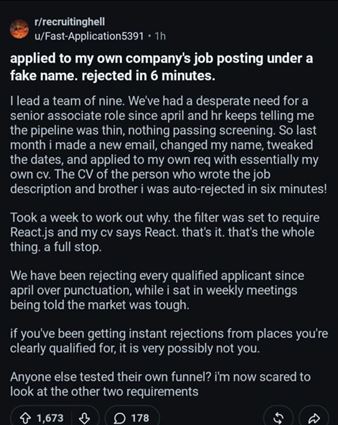
The story is anecdotal and cannot establish how frequently this occurs. What its reach does demonstrate is how readily candidates recognized the experience it described: the suspicion that a capable applicant can be eliminated by an automated process before a human considers the evidence.
That suspicion sits alongside another familiar complaint. Applicants report completing multiple technical interviews or live coding exercises - sometimes as many as five - only to hear nothing further. Others believe their CV never reaches a human because of overly aggressive filtering.
On the flip side, technology employers continue to report thin pipelines and difficulty filling vacancies. Experienced software developers, testers, technical writers, and other technology professionals describe sending carefully targeted applications into what appears to be a void. Recruiters say they are overwhelmed by unsuitable applicants; candidates say they cannot reach a human decision-maker. Both accounts can be true.
This is the central paradox of modern recruitment technology: genuine roles and capable candidates exist, but the systems intended to connect them are often better at processing and eliminating applications than at recognizing potential.
As a QA professional, I find this especially revealing. In software testing, a system is not judged solely by whether it follows its specified process. It is judged by whether it produces the intended outcome. A process that operates efficiently but repeatedly produces the wrong result is not successful automation. It is a defect operating at scale.
The coexistence of available talent and demand
The evidence does not support the simple conclusion that genuine technology vacancies no longer exist.
The Bundesagentur für Arbeit reported that Germany had approximately 16,000 registered vacancies in ICT occupations in 2024 and continued to identify recruitment bottlenecks, particularly in software development and programming.1 Eurostat found that 57.5 percent of EU companies that had recruited or attempted to recruit ICT specialists experienced difficulty filling those vacancies. In Germany, the figure was 72.41 percent.2
Industry figures point in the same direction. Bitkom estimated that 109,000 IT positions in Germany remained unfilled in 2025, while 85 percent of the companies it surveyed perceived a shortage of IT specialists.3
Those figures need context. The Bitkom number is an industry survey estimate rather than an official count, and a vacancy is not necessarily a funded role that an employer intends to fill immediately. Some advertisements represent evergreen recruitment, speculative demand, paused budgets, or positions that have effectively ceased to exist. Nevertheless, the combined evidence indicates that substantial real demand remains.
Nor is there an absence of available talent. The Bundesagentur für Arbeit recorded 43,000 unemployed people seeking ICT work in 2024 - 30 percent more than in the previous year.1 Bitkom found that 52 percent of companies expected better opportunities to recruit IT professionals because other employers were reducing staff.2
These figures do not mean that every available candidate matches every vacancy. They do, however, describe a market in which employers say they cannot find people while qualified people say they cannot reach employers. That suggests a matching failure - not merely a shortage on one side of the equation.
What an ATS really optimizes
An applicant tracking system (ATS) is not inherently a rejection machine. At its most basic, it is a database and workflow tool that records applications and helps recruiters move candidates through a hiring process. More sophisticated systems can parse CVs, rank applications, ask screening questions, identify keywords, and recommend or automatically apply rejection rules.
The problem is not simply that employers use an ATS. It is what they ask it to optimize.
The 2021 Harvard Business School and Accenture report Hidden Workers: Untapped Talent examined this question through surveys of more than 8,000 workers and more than 2,250 executives in Germany, the UK, and the US. More than 90 percent of surveyed employers used recruiting systems initially to filter or rank middle- and high-skilled candidates. Most strikingly, 88 percent agreed that qualified high-skilled applicants were excluded because they did not match the exact criteria established in the job description. For middle-skilled workers, the figure was 94 percent. The study covers the broader labor market rather than technology recruitment alone, but the filtering problem it identifies is directly relevant.4
These systems frequently use proxies for capability: a particular degree, an uninterrupted employment history, an exact number of years in a role, precisely named technologies, even age (for someone over 50, this criterion particularly grates: I know that I am still in my professional prime). Although these are not necessarily reliable predictors of whether someone will perform well, they are easy for software to evaluate.
Technology recruitment provides an obvious example. A candidate may have extensive browser automation experience but not the particular framework named in the vacancy. A senior tester may understand API testing, CI/CD pipelines, risk-based testing, and regulated environments, yet be rejected for lacking an exact combination of tools. Someone with six highly relevant skills may disappear because the CV does not contain the seventh phrase expected by a filter.
I have firsthand experience of this. A recruiter once told me that my CV would not be considered for a technical writer role because I had not listed experience with draw.io. I had never used it, but within minutes I understood the interface, and shortly afterward, I produced a complete flowchart with a legend and consistent color scheme. The missing keyword revealed very little about my ability to perform the work.
The system was working as configured: it reduced the pile. Whether it identified a strong candidate was a different question.
The requirements problem comes first
An ATS cannot rescue a badly defined vacancy. It can only apply its rules consistently.
Job descriptions often accumulate requirements over time. Skills possessed by the previous employee, preferences contributed by several stakeholders, and technologies that might conceivably become relevant are combined into a profile for an idealized candidate. “Nice to have” gradually becomes “required.” The result may describe someone who does not exist - or someone who exists but has little reason to accept the salary and conditions on offer.
This is a typical requirements engineering failure. The organization has not separated essential acceptance criteria from preferences. It then automates those ambiguous or inflated requirements and interprets the scarcity it creates as evidence of a skills shortage.
Bitkom's own findings reveal some of this complexity: employers cited highly specific requirements concerning the newest technologies as one obstacle. They also reported salary mismatches, insufficient flexibility, language expectations, and slow internal hiring decisions.2 These are not all deficiencies in the candidate pool. Several are constraints created by the employer.
Automation does not remove human judgment from recruitment. It embeds earlier human judgments into the workflow, often making them harder to see or challenge.
Application volume creates a destructive feedback loop
Recruiters do face a genuine problem. Digital job boards, one-click applications, automated CV tailoring, and generative AI have made it possible to apply for far more roles in far less time. Every vacancy can attract applicants from a much larger geographical and professional pool, including many who match few of the requirements.
Greenhouse reported that recruiter workload had risen by 26 percent in a single quarter, while 38 percent of surveyed job seekers acknowledged mass applying.5 Faced with that volume, employers introduce more screening questions and more aggressive filtering. Candidates experience poor response rates and compensate by submitting still more applications. Recruiters then receive even more noise.
It is a self-reinforcing loop:
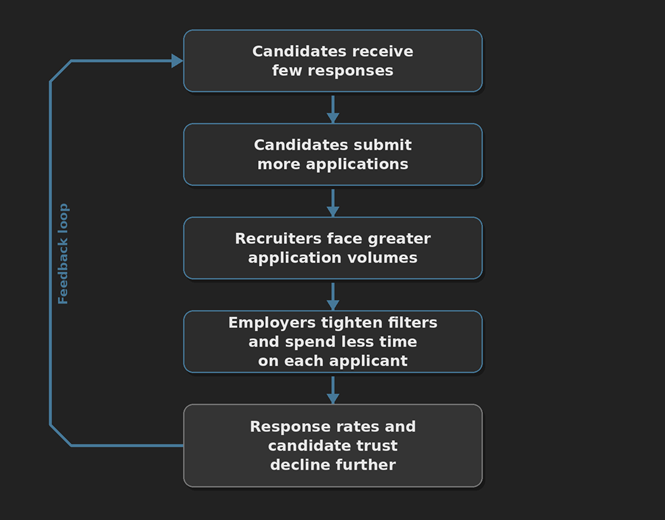
Each participant may be responding rationally to immediate incentives. Collectively, however, they produce an increasingly dysfunctional market.
Ghosting removes feedback and accountability
Ghosting, which has become normalized, is sometimes dismissed as a matter of etiquette. It is more consequential than that: it removes the feedback and accountability required for any process to improve.
Greenhouse's survey of 2,500 workers across Germany, the UK, and the US found that 61 percent had been ghosted after an interview. Its platform data also classified between 18 and 22 percent of posted positions in a typical quarter as “ghost jobs” - roles advertised without an active intention to hire.5 These figures come from an ATS provider and should not automatically be generalized to the entire labor market, but they demonstrate that candidate frustration is not merely anecdotal.
As deplorable as being ghosted feels for the ghostee, however, not all silence is deliberately disrespectful. A recruiter may be waiting for a client, a hiring manager may postpone a decision, or a budget may be withdrawn without formally closing the vacancy. Responsibility can become so distributed that nobody feels individually responsible for telling the candidate what happened.
Modern systems make silent rejection operationally easy. A record can remain inactive or be closed with no meaningful explanation. Recruiters and hiring managers receive no challenge to their assumptions, candidates learn nothing from the process, and the organization gains no evidence about whether its filters rejected the wrong people.
Whether intentional or not, ghosting has the effect of protecting a poor matching process from scrutiny. An employer can continue reporting that it found no suitable candidates without having to explain why experienced applicants were excluded or abandoned.
Are the strongest candidates reaching humans?
In some organizations, certainly. Good recruiters use technology to organize applications rather than replace professional judgment. They challenge unrealistic job descriptions, search for transferable skills, keep candidates informed, and treat automated recommendations as inputs rather than decisions.
No selection process can identify an objectively “strongest” candidate with certainty. The relevant question is whether it reliably surfaces people with strong evidence that they can perform the work. Across the market, however, candidate reduction can easily become a proxy for a successful process. Time to hire, cost per hire, and the number of applications processed are comparatively easy to measure.
The number of capable people incorrectly rejected is largely invisible because, having never been hired, their performance cannot be observed. This creates a dangerous asymmetry: a poor hire eventually becomes visible, whereas a strong applicant rejected before human review does not. In testing terms, conventional recruitment metrics measure throughput more readily than false negatives.
The HBS research is particularly important here. Companies that deliberately recruited people normally hidden by conventional processes were 36 percent less likely to report talent or skills shortages. They also reported that these employees performed as well as or better than traditionally sourced workers across measures including productivity, work quality, engagement, attendance, innovation, and work ethic.4
The barrier was therefore not necessarily capability. It was visibility within the selection system.
What would a better system optimize?
A better-designed recruitment process would not abandon automation. With modern application volumes, that would be neither realistic nor desirable. It would instead use automation to identify evidence of capability rather than merely eliminate imperfect profiles.
That would mean:
- separating essential requirements from preferences before publishing a vacancy;
- testing whether each rejection criterion predicts success in the actual role;
- searching for related and transferable experience rather than exact vocabulary alone;
- auditing automated decisions for false negatives;
- allowing recruiters to review candidates close to, but not identical to, the specified profile;
- recording why vacancies are paused, canceled, or repeatedly reopened;
- assigning clear ownership for candidate communication;
- measuring quality of hire and candidate experience, not only speed and cost; and
- ensuring that every interviewed candidate receives a clear outcome.
None of these measures requires abandoning the ATS. They require treating it as a system whose outputs must be tested.
Conclusion
The question is not whether recruitment technology is good or bad. The more useful question is whether the entire recruitment system is producing the outcome it claims to pursue.
Employers have vacancies. Skilled people are looking for work. Recruiters have access to more candidates, more data, and more automation than ever before. Yet communication has deteriorated, requirements have become increasingly exact, and qualified applicants can disappear without human consideration or explanation.
That is not simply a technology problem. It is a problem of requirements, incentives, ownership, measurement, and professional practice. The ATS is the mechanism through which many of those decisions are implemented, but the organization determines what the mechanism values.
At present, too many recruitment systems appear to be optimized for making an overwhelming pile of applications smaller. That is not the same as identifying the strongest available candidates. Until employers begin examining the capable people their processes exclude - not merely the speed with which they exclude them - some apparently persistent skills shortages may remain partly manufactured by the hiring process itself.
That leaves a genuine opportunity for a different kind of recruitment model: one that measures success by the quality of the match rather than the efficiency of the filter, and uses technology to bring capable people and employers closer together instead of driving a digital wedge between them.
Sources
- Bundesagentur für Arbeit, Der Arbeitsmarkt für IKT-Berufe im Kontext der Transformation (June 2025). ↩↩
- Eurostat, ICT specialists: statistics on hard-to-fill vacancies in enterprises. ↩
- Bitkom, Der Arbeitsmarkt für IT-Fachkräfte: Studie 2025. ↩↩↩
- Joseph B. Fuller et al., Harvard Business School and Accenture, Hidden Workers: Untapped Talent. ↩↩
- Greenhouse, State of Job Hunting report. ↩↩